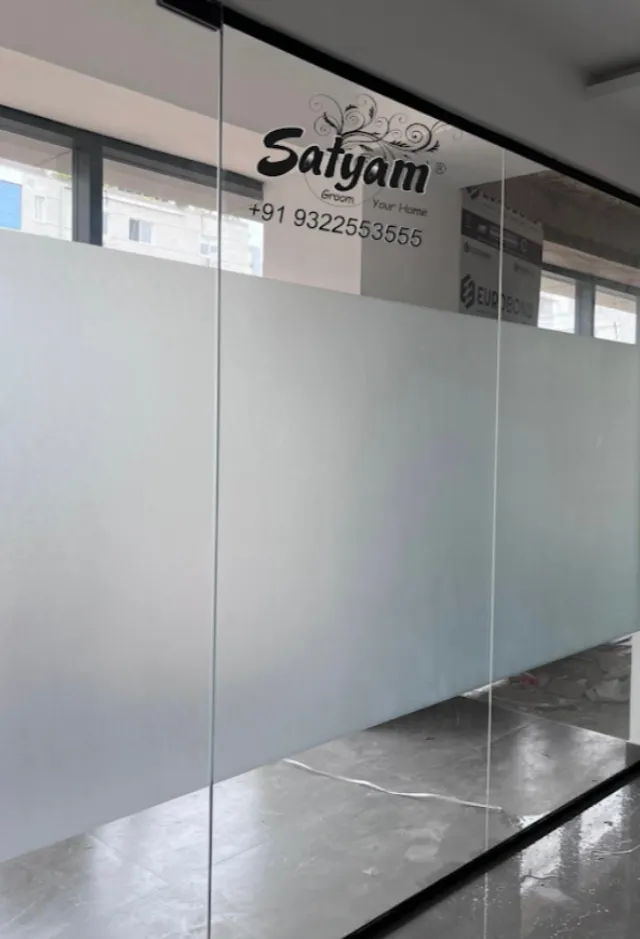
Glass is widely used in modern interiors because it allows light to move through a space and creates an open appearance. The challenge is that clear glass may provide less privacy than a bedroom, office cabin, clinic, meeting room, or commercial property requires. Glass Films can help modify transparency and appearance without necessarily replacing the existing glass.
For properties in Thane, Maharashtra, the effectiveness of the finished installation depends heavily on choosing the film for the right purpose.
1: Choosing appearance before function
Decorative designs can be attractive, but the first question should be what the film needs to achieve.
Possible requirements include:
- Increasing visual privacy
- Adding decorative character
- Reducing glare
- Creating visual separation
- Improving the appearance of partitions
- Marking large glass surfaces for visibility
Different products are designed for different applications. Selecting purely from a pattern catalogue can result in a film that looks good but does not address the original requirement.
2: Assuming every privacy film works identically
Privacy is not a single standard.
Frosted effects can obscure direct visibility while allowing light through. Decorative patterns may provide only partial screening. Other film types can behave differently depending on lighting conditions on each side of the glass.
It is therefore important to understand how the selected product performs in the actual environment, particularly during both daytime and evening use.
3: Ignoring the condition of the glass
Film is applied directly to the glass surface, so cleanliness and surface condition matter.
Dust, residue, old adhesive, scratches, or contaminants can affect the final appearance. Existing glass should be evaluated and prepared correctly before installation.
A high-quality film cannot hide every defect already present in the glass.
4: Using too much decorative pattern
A decorative film can add character to an office partition or residential window, but extensive use of bold patterns may make an interior feel visually crowded.
The design should complement furniture, wall finishes, flooring, curtains, and the architectural character of the space.
Minimal patterns are often effective in professional settings, while residential interiors can offer more freedom for decorative choices.
5: Forgetting about lighting
Glass film interacts with both natural and artificial light.
A sample viewed against a bright showroom window can look different when installed on an internal office partition. Similarly, privacy performance may appear different when one side of the glass is significantly brighter than the other.
Evaluate the expected lighting conditions before finalising the film.
6: Treating installation as an afterthought
Bubbles, uneven edges, contamination, and poor alignment can affect an otherwise suitable product.
Accurate cutting and careful surface preparation contribute substantially to the final finish, particularly with patterned films where alignment is visually noticeable.
Satyam Furnishing provides furnishing and interior décor solutions for customers in Thane, including applications where window treatments and glass finishes need to work together within the same space.
Well-chosen Glass Films can improve privacy and transform ordinary glass into a useful design element. The key is to define the purpose first, understand privacy expectations, evaluate lighting and glass condition, and select a design that supports rather than overwhelms the interior.
Keywords