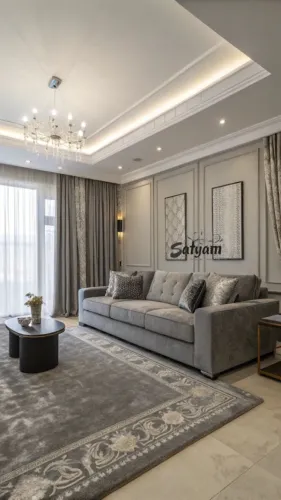

A feature wall succeeds when its image, scale and placement work with the room rather than competing with doors, windows, furniture and lighting. By planning the wall, measuring the surface, checking a physical proof and matching the material to the room’s conditions, you can create a personalised focal point that looks intentional and installs cleanly.
Key takeaways
- Choose an uninterrupted wall visible from the room’s main entrance or seating area.
- Measure wall width, height, openings and panel overlap before ordering wallpaper.
- Match artwork scale to room size and coordinate it with existing colours.
- Approve a full-size proof and check material performance before production.
Choose the Wall That Has the Clearest Visual Role
Choose the wall that naturally catches attention when you enter the room or sit in its main seating area. That wall should have enough uninterrupted surface for the artwork to read clearly, rather than forcing important details behind windows, doors, switches, sockets or built-in furniture.
Plan wallpaper placement on the actual wall elevation, not a blank rectangle. Mark every fitting and decide where the panel joins and where the image crops; mathematical centring can put a face, artwork detail or key motif behind a door handle or light switch.
Use these checks before selecting the feature wall:
- Choose a wide, uninterrupted wall for panoramic scenes or large-scale artwork.
- Use the wall behind a bed, sofa, dining table or reception desk when you want the wallpaper to reinforce an existing focal point.
- Treat alcoves and niches as contained accents; a bold design can make them feel intentional, while covering every surrounding wall can make the room busy.
- Reject walls with leaks, condensation, cracks, grease, loose paint or uneven surfaces until they are repaired, cleaned, filled, sanded and primed.
Wall condition and surrounding openings change the best choice:
| Wall type | Strength | Main risk |
|---|---|---|
| Uninterrupted wall | Shows the full image | Needs careful scale selection |
| Wall with windows and doors | Can frame the design | Cropping and panel joins become critical |
| Wall behind furniture | Creates a clear backdrop | Furniture may hide the focal detail |
| Damp or condensation-prone wall | Rarely suitable for ordinary wallpaper | Adhesive failure and mould behind the covering |
A feature wall succeeds when the room’s movement, furniture and lighting all point toward it—not when it is merely the largest available wall.
Measure the Wall for Panels, Pattern Matching and Waste
Wallpaper measurement starts with the wall height and width, not floor area. A 3 m-wide wall that is 2.7 m high can need more material than its area suggests if the design has a large pattern repeat.
1. Measure the finished height at the left, centre and right, then use the largest figure. Measure the width at the top, middle and bottom and use the largest width. Record doors, windows, sockets, switches and built-in furniture on a wall sketch.
2. Confirm the supplied panel or roll width. Divide the wall width by that width and round up to find the number of drops. For roll wallpaper, round each drop length up to a full multiple of the pattern repeat, then add trimming allowance at the top and bottom.
This gives the cut length per drop.
3. Multiply the number of drops by the cut length, then compare that total with the roll length or the supplier’s panel schedule. Custom murals usually arrive as numbered panels, so request a layout showing panel widths, sequence and the image crop.
4. Do not automatically subtract doors and windows. Their position can force a full panel and create unusable off-cuts; deduct an opening only after the installer confirms the cutting plan. Order extra material for pattern matching, damaged edges and installation errors, especially with large repeats.
Lay the proposed panels over the actual wall sketch before ordering. Shift joins away from faces, key artwork and fittings, because a mathematically centred image can place its focal detail behind a switch or cabinet.
Match the Design Scale to the Room and Its Existing Palette
A large motif needs visual breathing room, so reserve it for a broad, uninterrupted wall. A panoramic mural suits a wide surface because its horizon and details can spread without forcing the eye around corners; choose a smaller repeat for a narrow room, short wall, or space already filled with furniture.
Use the room’s existing palette to control the image rather than selecting a favourite picture in isolation. Check the flooring, furniture finishes, lighting colour, curtains and upholstery coordination, then choose artwork with one dominant tone and a limited number of supporting accents.
A detailed personalised artwork can look crowded when every object has a contrasting colour or sharp outline.
Before approving the image, place its layout over a photograph or measured drawing of the actual wall. Show every opening and obstruction:
- Doors and windows, so a face, horizon, or central motif does not disappear behind a frame.
- Switches, sockets, niches, alcoves, and built-in furniture, so important details remain visible.
- Panel joins and the intended crop, because mathematical centring can put the focal point behind a fitting.
- Corners and sightlines, because a design that turns onto an uneven corner can step visibly.
If the wall already carries patterned upholstery or bold flooring, reduce the wallpaper’s detail and contrast. Let one feature lead; the others should support it. A physical colour sample is essential for saturated shades, skin tones, and close matches, since a phone display cannot predict the full-wall result.
Approve the Proof Before the Wallpaper Goes Into Production
Approve the wallpaper proof before production, because a small design error becomes a full-wall problem once the panels are printed.
1. Check colour accuracy with a physical sample or strike-off, not only a phone or monitor image. View it in the room’s daylight and artificial lighting, especially for saturated colours, skin tones, photographic murals, or close matches to curtains and upholstery.
2. Inspect image resolution at the intended print size. Edges, faces, fine lettering, and architectural lines should look sharp without visible pixels or blurred details. A file that looks clear on a screen can appear soft when enlarged across several panels.
3. Confirm the crop and repeat. Make sure the important part of the image is not cut off at the ceiling, skirting, window, or panel edge, and check that repeated motifs align where the design requires it.
4. Request the panel layout with numbered drops, finished dimensions, trimming allowances, and the installation sequence. Reversing panels or trimming the wrong edge can break a continuous mural.
5. Examine a seam sample. Confirm whether the product requires butt joints rather than overlap, and check that the printed image meets cleanly without a dark line, ridge, or colour shift.
6. Sign off only after checking the proof against the approved artwork, wall measurements, and material specification. Keep the approved version for comparison when the finished panels arrive.
Check Material Behaviour Before Using It in a Demanding Location
Laminated PVC wallpaper can work well on interior feature walls, corridors, reception areas and humid areas such as well-ventilated bathrooms or kitchens, provided the wall itself is dry and the product is approved for that location. It is not a repair for seepage: trapped moisture can loosen the adhesive and encourage mould behind the covering.
Before ordering, confirm these performance details in writing:
1. Moisture resistance and installation limits: check whether the covering tolerates humidity, condensation and occasional splashes. Do not use it inside a shower enclosure or over a damp wall unless the manufacturer specifically approves it.
2. Lightfastness: ask for the rating when the wall receives direct sunlight and heat through a large window. UV exposure can fade a printed image, while heat can stress the adhesive and expose weak seams.
3. Cleaning and contact resistance: “washable” does not automatically mean detergent-safe or scrub-resistant. Confirm resistance to water, household cleaner, stains and repeated wiping if the wall sits behind a dining table, basin or children’s activity area.
4. Construction and installation: verify the 6 mm thickness, panel sequence, adhesive type, edge treatment and substrate requirements. A thick covering still fails over dust, grease, cracks or loose paint.
SATYAM FURNISHING 9322553555 can help you compare a laminated PVC wallpaper sample with the room’s exposure and cleaning demands, rather than selecting by image alone. Get the care instructions and warranty terms before production.
Related product
 | Wallpaper ₹110 Customised wallpaper from Satyam Furnishing offers a unique way to transform any room into a personalised space. View product → |
Frequently asked questions
Which wall is best for customised wallpaper?
Choose the uninterrupted wall that naturally catches attention when entering the room or sitting in its main seating area. Keep key artwork away from windows, doors, switches, sockets and built-in furniture.
What should you measure before ordering custom wallpaper?
Measure the wall’s full width and height, then record windows, doors, sockets, switches and other interruptions. Confirm panel dimensions, pattern matching and the supplier’s required allowance for trimming and waste.
How do you choose the right wallpaper design scale?
Match large artwork and motifs to walls with enough viewing distance, and use smaller patterns when the room is compact or visually busy. Compare the design with the room’s existing colours and furnishings.
Why approve a wallpaper proof before production?
A proof lets you check the artwork crop, colours, pattern scale, panel joins and placement of important details before the final wallpaper is printed.
What material checks matter for demanding locations?
Check how the wallpaper handles moisture, cleaning, sunlight, abrasion and installation conditions before using it in kitchens, bathrooms, hospitality spaces, offices or healthcare facilities.