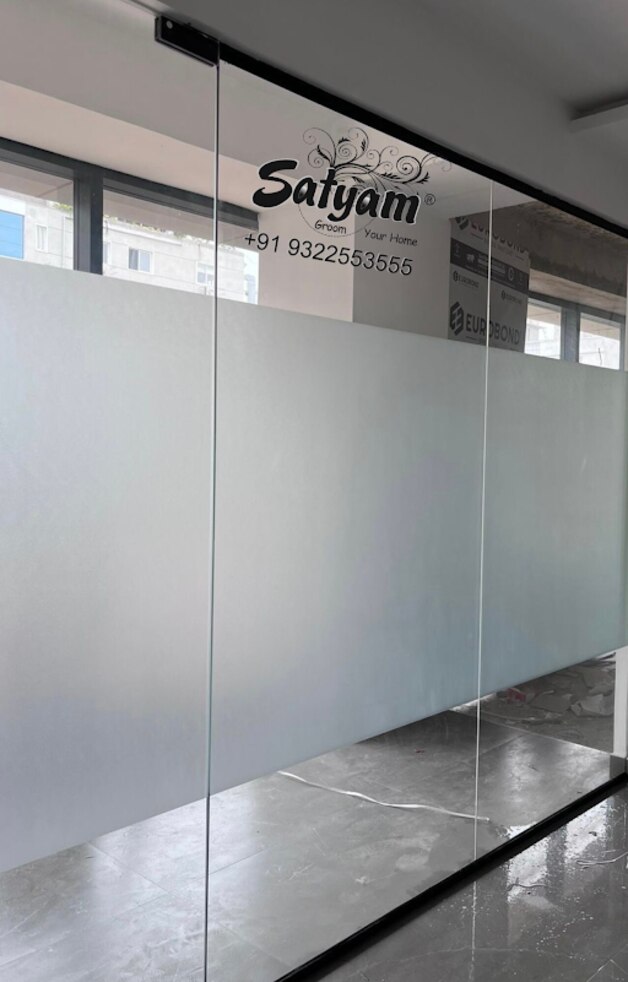
Privacy film works by controlling what people can see, but every option changes the amount, direction, or quality of daylight entering through the glass. By comparing film types, privacy levels, sightlines, and real-world lighting conditions, you can choose a solution that screens the right view without making the room unnecessarily dark.
Key takeaways
- Frosted and etched films provide privacy without relying on reflected light.
- Reflective films lose privacy when indoor lights exceed outdoor brightness.
- Test samples at eye level during daylight and after dark.
- Combine film with blinds or curtains when nighttime privacy matters.
How frosted, etched, reflective, tinted, and switchable films compare
A high visible light transmittance (VLT) keeps a room brighter, but it usually provides less screening. Use this privacy film comparison to match the film to your need:
| Option | Privacy and daylight | Appearance and cost |
|---|---|---|
| Frosted film | Obscures faces and objects while admitting diffuse daylight; silhouettes and shadows can remain | Soft, matte appearance; usually low to moderate cost |
| Etched film | Similar light scattering, with patterns or bands that control the covered area; clear outward views are lost | Decorative glass-like finish; moderate cost depending on pattern |
| Reflective film | Strong daytime screening when outdoors is brighter than indoors; it can fail at night when interior lights are on | Mirror-like exterior appearance; moderate cost |
| Tinted film | Reduces brightness and glare but offers limited privacy because shapes remain visible | Coloured or smoke-like glass effect; usually low to moderate cost |
| Switchable film | Changes from clear to opaque or translucent, giving adjustable privacy without a permanent blur | Clean, modern appearance; highest cost and requires electrical installation |
Choose frosted film or etched film for bathrooms, street-facing glass, and offices needing consistent screening. Denser patterns provide stronger privacy but reduce daylight and make the window look busier.
Choose reflective film for daytime privacy and solar control, not guaranteed nighttime privacy. Tinted film suits glare reduction when you still want an outward view. Switchable film costs more but preserves that view when privacy is unnecessary; curtains or blinds offer a lower-cost second mode. Check the film’s VLT before ordering.
Choose privacy by room, viewing angle, and line of sight
Cover the glass where the unwanted sightline passes, not automatically from edge to edge. Trace views from standing and seated positions outside, including oblique angles from a walkway or neighbouring building; a narrow eye-level band can work for faces, while a full-pane treatment is needed when people could watch movement throughout the room.
| Room | Main privacy concern | Glass coverage to specify |
|---|---|---|
| Bathroom | Direct views of a person | Cover from the sill to above standing eye level, or the entire pane when nearby buildings overlook it. |
| Bedroom window privacy | People seeing occupants, movement, or silhouettes | Cover the full visible pane if observers can look in while standing; lower-half film alone leaves standing views exposed. |
| Conference room | Faces, screens, and discussions | Cover the eye-level zone across the full width, extending above seated head height; use full coverage if people stand or walk close to the glass. |
| Reception area privacy | Visitors seeing desks, documents, or staff activity | Cover the band from seated eye height through standing eye height, using a wider or full-pane treatment where the public approaches from the side. |
A film covering only the lower half fails when the observer stands on a raised path or looks down from another floor. Patterned or denser film protects better than plain translucent film when silhouettes and shadows matter.
For glass facing a street, combine a privacy film with a blind or curtain if you need clear views by day but dependable privacy after dark; reflective film loses its advantage when indoor lights are brighter than outside.
Understand daylight, nighttime privacy, glare, and outward views
Visible light transmittance (VLT) gives you the clearest estimate of how bright the room will remain. A high-VLT film preserves more daylight but usually offers weaker screening; a low-VLT film darkens the glass and strengthens privacy.
VLT does not predict the view by itself: a translucent film can transmit plenty of light while scattering faces, trees, and sky into indistinct shapes.
| Option | Daylight and outward view | Privacy and glare effect |
|---|---|---|
| High-VLT decorative film | Keeps the room brighter; softens details rather than removing all visual connection | Moderate screening; some glare reduction through diffusion |
| Frosted or translucent film | Admits diffuse daylight but turns the outward view into blur or an opaque field | Consistent screening; reduces sharp sunlight and visual distractions |
| Reflective daytime privacy film | Preserves a more recognizable outward view when the exterior is brighter | Strong daytime privacy and glare reduction; advantage can reverse after dark |
A daytime privacy film is not one-way glass. With interior lights on at night, the brighter room can become visible from outside, so plan nighttime privacy with curtains, blinds, frosted sections, or a switchable layer. Test the actual pane at morning, afternoon, and after dark before choosing.
East- and west-facing windows deserve special attention because low-angle sun creates glare even in a bright room. Compare VLT with glare reduction and solar heat rejection; a film marketed as “100% privacy” cannot promise both daylight and a clear outward view.
Test the film on your actual glass before committing
Test a sample on the actual pane before ordering enough film for the room. A showroom swatch cannot reveal how the film changes your glass’s colour, reflected image, brightness, or view at different times of day.
1. Clean one test area and apply a large sample, not a small corner. View it from both sides in daylight, with the room lights on after dark. Check whether faces, furniture, and outdoor views are obscured as expected, and note glare or reflections at eye level.
2. Compare the sample beside untreated glass at morning, midday, and late afternoon. East- and west-facing windows can look acceptable at noon but produce strong glare when low-angle sunlight hits them. Ask for the film’s visible light transmission (VLT) figure and compare the room’s brightness rather than relying on labels such as “light” or “heat-proof.”
3. Identify the existing pane before installation. Tell the installer whether it is single glass, an insulating glass unit, tinted glass, coated glass, or tempered and laminated glass. Confirm double glazing compatibility in writing, including any limits for pane orientation, size, coatings, and solar exposure.
4. Read the film manufacturer’s warranty conditions before approval. Privacy film is not security film; do not treat the sample as protection against impact or forced entry.
5. Judge the finished sample only after the stated film installation and curing period. Temporary haze and small water pockets are normal during curing, so do not scrape or clean the surface early. Follow the installer’s specified cleaning method.
Specify the complete privacy solution, not just the film
A complete privacy solution must match the film to the glass, the sunlight, and the way you use the room. Confirm these points in writing before ordering:
1. Ask for visible light transmission (VLT), glare reduction, solar heat-rejection data, and the privacy result in both daylight and artificial light. A “100% privacy” claim is not a performance specification.
2. Decide whether privacy stays permanently present. A switchable privacy film provides clear and opaque modes, while frosted film remains in place; curtains, blinds, or shades add a second operating mode when you want the outdoor view.
3. Use a solar-control film to reduce incoming solar radiation, glare, and ultraviolet exposure, not as a substitute for insulating glass or low-emissivity glass. External shading stops more heat before it reaches the pane, especially on large east- and west-facing windows.
4. Keep the privacy film versus security film distinction clear. Decorative film does not stop forced entry, impact, or glass breakage unless it forms part of a tested safety or security glazing system with specified thickness and edge attachment.
5. Have a qualified installer identify whether the pane is single, tinted, laminated, coated, or insulating glass, then confirm compatibility, warranty conditions, edge clearance, surface preparation, curing time, and window film maintenance.
SATYAM FURNISHING 9322553555 can help compare a film with wooden Venetian blinds or curtains when you need adjustable privacy rather than a permanent visual screen.
Related product
 | Glass Film ₹50 Glass films have become an essential part of modern interior design, and Satyam Furnishing in Thane is known for offering a wide variety of... View product → |
Frequently asked questions
Which glass film provides the most reliable privacy while preserving daylight?
Frosted and etched films diffuse the view while admitting daylight. Choose their coverage and opacity based on the sightline you need to block.
Do reflective films provide privacy at night?
Only when the outside remains brighter than the room. After dark, indoor lights can reverse the effect, so add curtains, blinds or another privacy layer.
How should you choose privacy film for a room?
Identify the room’s viewing angles and line of sight first. Bathrooms and street-facing rooms often need continuous screening, while offices may need privacy only across eye level.
What should you check before installing glass film?
Test a sample on the actual glass at different times of day. Check daylight, glare, nighttime visibility, outward views and the result from the main outside viewing angle.