A wallpaper design can look attractive on its own yet feel wrong once it meets your flooring, furniture, lighting and fixed architectural features. By turning the room into a clear design brief, testing colour and scale in real conditions, and planning coverage and panel joins before ordering, you can create a wall treatment that belongs to the whole space.
Key takeaways
- Write the room’s purpose, mood and focal wall into the design brief.
- Sample colours beside flooring, upholstery, curtains and furniture before choosing wallpaper.
- Match pattern scale and coverage to wall size, ceiling height and visual clutter.
- Check measurements, natural light, wall condition and moisture before ordering.
Turn the Room’s Character Into a Wallpaper Brief
Start with the room’s job, not a wallpaper catalogue. A customised wallpaper design brief should state the room theme, intended mood, architectural character and wallpaper focal point before you consider a pattern.
Record whether the space should feel calm, dramatic, natural, formal or playful, then note its interior style, ceiling height and the main furniture that will sit against the wall.
- Name the room’s visual role: quiet backdrop, statement wall or immersive setting.
- Identify the strongest architectural feature, such as panelling, an arch, a fireplace or a large window.
- Choose the focal point: the wall behind a bed, sofa, dining table or console.
- Describe the pattern scale in relation to nearby furniture, not the wall alone.
| Concept direction | Best fit | Watch for |
|---|---|---|
| Quiet botanical or texture | A room with prominent furniture, artwork or curtains | A tiny repeat disappearing on a large wall |
| Large mural or oversized motif | One clear focal wall with open viewing space | Cabinets, doors or windows cutting through the main image |
| All-over geometric or small repeat | Balanced rooms needing consistent coverage | High contrast becoming busy across every wall |
A strong brief also lists what the wallpaper must not compete with. If the room already has ornate upholstery or bold artwork, specify a restrained background; if the furniture is simple, allow the wallpaper to carry more visual weight. That decision gives the design a purpose instead of leaving the pattern to dominate by accident.
Build the Colour Scheme From the Whole Room
Choose wallpaper colours by comparing the whole room, not by copying one sofa or curtain. Successful wallpaper colour matching usually repeats one or two related colours while allowing differences in texture, depth and finish.
| Room element | What to examine | Coordination decision |
|---|---|---|
| Flooring | Wood, stone, tile and rug undertones | Match warm or cool undertones before choosing the wallpaper colour |
| Furniture and upholstery | Main fabric colour, timber stain and leather tone | Repeat a supporting shade rather than copying the dominant surface exactly |
| Curtains and artwork | Pattern, contrast and accent colours | Keep wallpaper quieter when these already provide a strong focal point |
| Paint and lighting | Wall colour, daylight direction and bulb warmth | Check whether the scheme shifts under warm or cool colours and light |
Warm undertones include yellow, red and peach; cool undertones include blue, green and blue-grey. A beige wallpaper with pink undertones can look discordant beside yellow-beige flooring, even when both appear neutral in a catalogue.
Check Light Reflectance Value wallpaper samples on the intended wall. LRV runs from about 0, which absorbs light, to 100, which reflects it; a low-LRV design can make a poorly lit room feel heavier, while a high-LRV design spreads available light.
Place a large sample beside the floor, curtains, upholstery and artwork. View it in morning, afternoon and evening light before ordering, because shadows and warm LED bulbs can change the colour noticeably. If several surfaces have bold patterns, give wallpaper a quieter texture or solid colour so the room does not become visually noisy.
Choose Coverage and Pattern Scale That Suit the Space
Choose coverage by deciding where the eye should land. Use feature wall wallpaper behind a bed, sofa or dining table when that wall has a clear focal role; keep nearby paint, curtains and upholstery quieter so the pattern does not compete with them.
| Coverage | Best use | Main risk |
|---|---|---|
| One wall | A strong focal point behind key furniture | The wall feels isolated if surrounding colours do not support it |
| Two walls | A corner, bed alcove or dining zone that needs enclosure | The pattern can overpower the room if both walls carry large furniture |
| Full-room wallpaper | A cohesive scheme with restrained furniture and accessories | A small, busy repeat can become tiring across every wall |
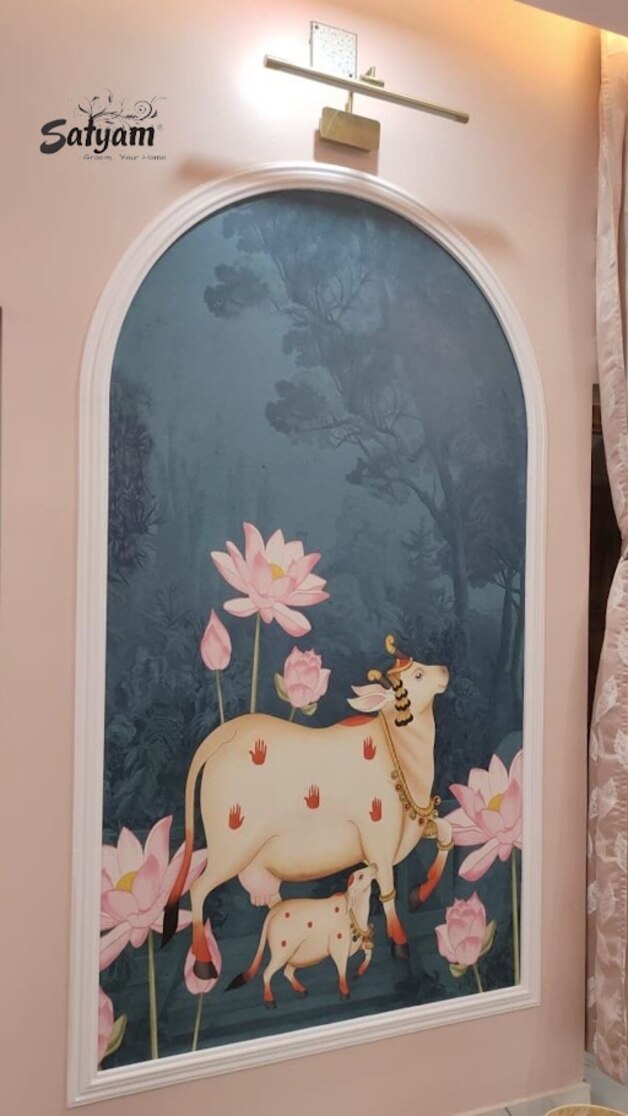
Match the wallpaper pattern scale to both the room and the furniture in front of it. A large mural or oversized botanical suits a broad, relatively clear wall; behind several cabinets or windows, its composition can look chopped up.
A small repeat can disappear in a large room but feel restless when repeated throughout a compact one.
- Choose large motifs for a deliberate focal wall with open visual space.
- Choose medium-scale patterns when furniture, artwork and windows already divide the wall.
- Choose small repeats for limited walls or rooms with substantial furniture, but check that they do not create visual noise.
- Use vertical stripes wallpaper to make the ceiling appear taller; use horizontal bands to make a wall seem wider and lower.
Strong stripes also expose crooked ceilings and uneven joins, so inspect the wall before ordering. Full-room wallpaper works best when accessories and upholstery provide texture rather than competing patterns.
Plan the Layout, Measurements and Motif Position Before Ordering
Measure each wall separately and mark doors, windows, switches, sockets and furniture on an elevation before ordering. This prevents a mural’s main subject from disappearing behind a bed or cupboard and stops a repeated motif landing awkwardly beside a doorway.
1. Record each wall’s width and height in millimetres. Measure from the finished floor to the ceiling, then note skirting boards, coving and every opening. Do not subtract doors or windows from the quantity automatically; wallpaper panels or rolls still need to cover full-width drops around them.
2. Check the product width, usable length, vertical repeat and matching method. Divide each wall width by the panel or roll width and round up to whole drops, then add enough length for the wall height and pattern alignment. Straight-match and drop-match designs create more pattern repeat waste than random-match designs.
3. Draw the furniture at its actual width and height. For mural placement, keep faces, flowers or other key subjects above or beside the furniture rather than directly behind a headboard, television or tall cabinet.
4. For a repeated motif, shift the starting drop so the pattern avoids door frames, window reveals and switchboards. Check the first and last drops at corners; a narrow cut strip can make the repeat look accidental.
5. Ask SATYAM FURNISHING 9322553555 to review a scaled elevation or digital composite before production, especially for a made-to-measure mural. Confirm the final panel sequence, trimming allowance and installation direction in writing.
Related product
 | Wallpaper ₹110 Customised wallpaper from Satyam Furnishing offers a unique way to transform any room into a personalised space. View product → |
Test the Design Against Light, Wall Condition and Moisture
A large sample on the intended wall gives a more reliable answer than a catalogue image or phone screen. View the wallpaper samples at three points:
- Morning, when daylight may be cooler or directional
- Afternoon, when shadows and sun exposure change the colour
- Evening, under the room’s artificial light, including warm LED bulbs
Check the sample beside the flooring, curtains and furniture. A dark, low-Light Reflectance Value (LRV) design absorbs more light and can make a poorly lit room feel heavier; a high-LRV design reflects more of the available light. Treat this as a lighting effect, not an automatic ban on dark wallpaper.
Wall preparation affects the finished design as much as the print. Repair cracks and ridges, remove old adhesive, smooth textured plaster, clean grease and prime glossy patches before installation. Thin or smooth wallpaper will expose these defects, while uneven surfaces can make seams look wider. Use the primer and adhesive specified for that wallcovering.
Confirm peel-and-stick wallpaper suitability before choosing it for a kitchen, rental or sunny room. Dust, grease, dampness, fresh paint, rough texture and changing humidity can cause lifting. Check the manufacturer’s requirements for paint-curing time, surface type and humidity, and reject wallpaper for a persistently damp wall until the moisture problem is fixed.
Frequently asked questions
What should a customised wallpaper design brief include?
State the room’s purpose, desired mood, theme, architectural character and the wall you want as the focal point.
How do you choose wallpaper colours for an existing room?
Build the palette from the whole room, including flooring, furniture, curtains, upholstery, lighting and accent pieces.
How do you choose the right wallpaper pattern scale?
Use larger motifs on spacious, less-cluttered walls and smaller patterns where furniture, openings or décor already create visual detail.
What should you measure before ordering custom wallpaper?
Measure each wall’s width and height, note doors and windows, and plan motif alignment, repeats, seams and extra material.
What should you test before installing wallpaper?
View a sample in daylight and artificial light, inspect the wall for cracks or dampness, and confirm the material suits moisture levels.